
Most clinics will not inject lip filler during pregnancy or breastfeeding. That is not because harm has been shown, but because nobody has shown it is safe, and the lips are not an area where you want to be guessing.
Below: what the evidence does and does not say, why the emergency treatment for filler complications is part of the picture, and how to plan treatment around pregnancy.
Key takeaways
- Safety of dermal filler in pregnancy and breastfeeding is unknown. The gap is a lack of data, not proof of harm.
- Hyaluronic acid resembles a substance the body makes, but manufacturers list pregnancy as a relative contraindication, and pregnancy increases vascularity.
- Lidocaine is not the main worry. The enzyme that dissolves filler in an emergency is the less comfortable part of the question.
- Lip filler is not permanent and fades over roughly 12 to 18 months, so waiting until after pregnancy and breastfeeding is a delay, not a loss.
What the evidence says
There is no evidence that lip filler harms a pregnancy, and no evidence that it is safe. The US FDA says the safety of dermal fillers is unknown during pregnancy and breastfeeding. Researchers reviewing cosmetic procedures in pregnancy found no reported cases of filler use, so the gap is a lack of data, not a finding
of harm.
Hyaluronic acid closely resembles the hyaluronic acid your body makes, yet manufacturers still list pregnancy as a relative contraindication. The material looks gentle, and the label stays cautious.
Why clinics still say wait
Lip filler is elective and not permanent, so waiting costs you a delay and little else. It slowly wears away, usually over 12 to 18 months. With no safety data on one side and a pause on the other, most clinics choose the pause.
If filler blocks a blood vessel, tissue death can follow unless it is spotted and treated quickly, and the treatment is an enzyme that dissolves the filler. That enzyme, hyaluronidase, is listed as Pregnancy Category C, and an animal study reported reduced fetal weight. The emergency remedy is not one you want to rely
on in pregnancy.
No part of the face is risk-free once a needle breaks the skin. Ideal candidates for lip filler are described as healthy people who are not pregnant or breastfeeding.
Anaesthetic and the dissolving enzyme
Numbing is the smaller worry. Lidocaine, the most common anaesthetic for lip filler, is rated pregnancy category B and is considered relatively safe at the doses used in skin procedures. A topical lidocaine and prilocaine cream is also considered safe. Other anaesthetics, such as bupivacaine and mepivacaine, are
category C, meaning no studies define their risk well.
The dissolving enzyme, hyaluronidase, is the bigger question. Its US prescribing information lists it as category C. An animal study found no birth defects but did report reduced fetal weight. Allergic reactions are rare.
Having filler during pregnancy means you could need that enzyme, with limited reassurance about it, at the worst possible moment.
Vascular risk and what changes in pregnancy
Vascular occlusion is rare, but it is the complication that makes lip filler more than a cosmetic detail. It happens when filler is accidentally injected into a blood vessel. If it is not recognised and treated promptly, the tissue can die.
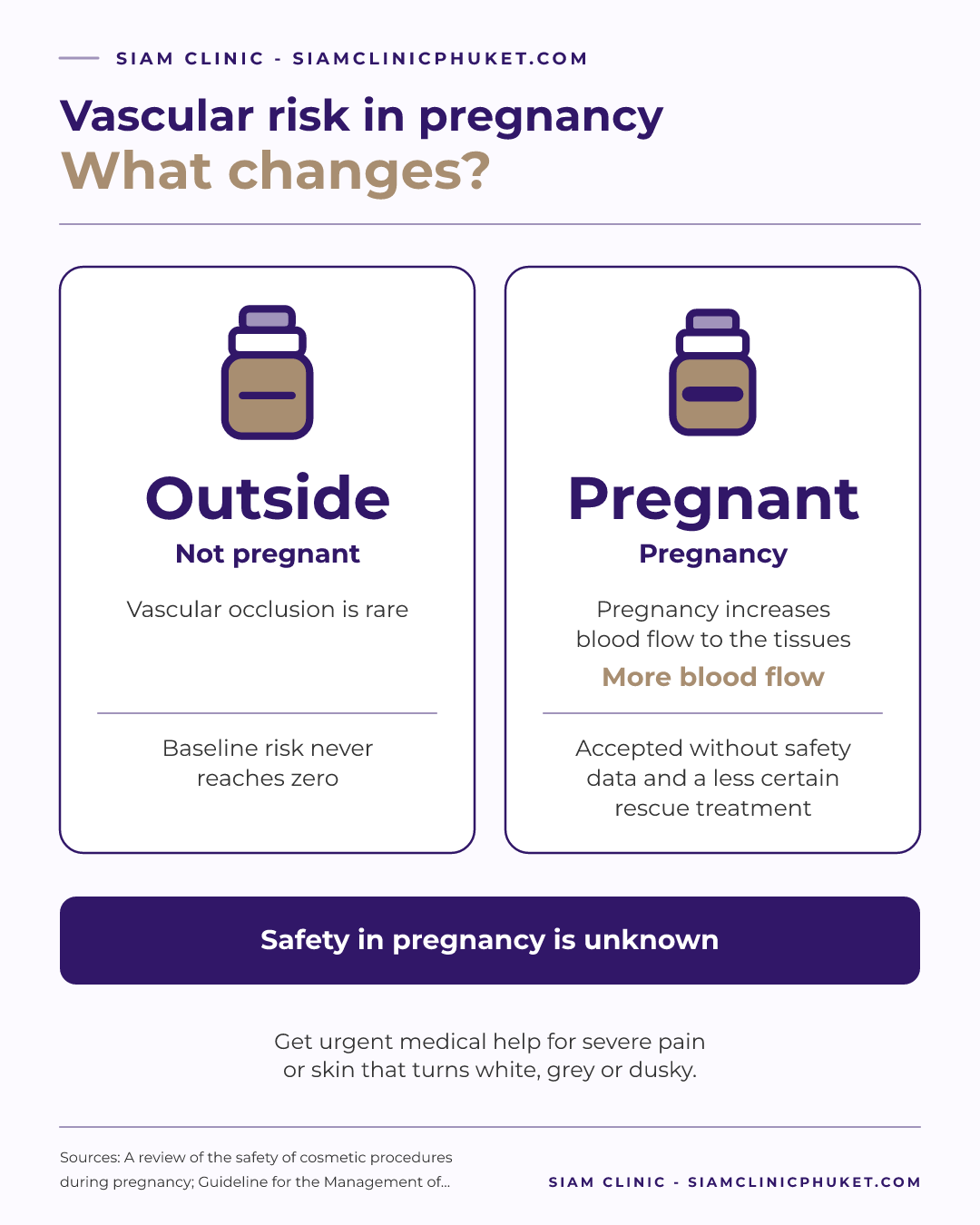
Pregnancy increases blood flow to the tissues, and it raises the risk of hyperpigmentation. Neither point proves that lip filler becomes more dangerous. But the baseline risk never reaches zero, and in pregnancy you would be accepting it without safety data and with a less certain rescue treatment.
Other risks are the usual ones: bleeding, infection, cold sore reactivation, asymmetry and lumps. These are manageable outside pregnancy.
Planning around pregnancy and breastfeeding
If you are pregnant or trying to conceive, the simplest plan is to book lip filler for after pregnancy and after you stop breastfeeding. Filler wears away slowly, so the wait is a delay and not a lost chance.
If you already have filler and then find out you are pregnant, there is no evidence that it harms the pregnancy. Do not rush to have it dissolved. Dissolving it uses an enzyme that has its own unanswered questions in pregnancy, so tell your doctor and decide together.
If you are planning a pregnancy soon, think about timing. A filler appointment just before trying to conceive leaves you with filler you cannot easily top up or fix for many months.
Who should be careful and when to see a doctor
Take extra care if you are pregnant, breastfeeding, under 22, or have a history of cold sores, since filler can reactivate them. The filler page on this site covers the wider list.
Get urgent medical help if, after any filler, you notice severe pain, skin that turns white, grey or dusky, or blotchy discolouration, since these can signal a blocked blood vessel.
Further reading: Dermal Fillers (Soft Tissue Fillers)
Further reading: A review of the safety of cosmetic procedures during pregnancy and lactation - PMC
Read next: Crows Feet Botox: Say Goodbye to Smile Lines Around Your Eyes
Read next: SAY GOODBYE TO OFFICE SYNDROME WITH INDIBA
This article provides general information only. It is not a diagnosis or personal medical advice. If you have symptoms or health concerns, please consult a qualified doctor.
About the author
siamclinicphuket
This article is based on the sources listed at the end.
Sources
- Dermal Fillers (Soft Tissue Fillers)
- A review of the safety of cosmetic procedures during pregnancy and lactation - PMC
- Dermatologic and Cosmetic Procedures in Pregnancy - PMC
- HYALURONIDASE- hyaluronidase injection, solution
- Guideline for the Management of Hyaluronic Acid Filler-induced Vascular Occlusion - PMC
- Lip Fillers: What to Expect, Types, Benefits & Side Effects
- Lip Filler Versus “Lip Flip”: Longitudinal Public Interest and a Brief Review of Literature - PMC
