For acne scars, fractional CO2 laser usually gives a bigger improvement than plain microneedling, while microneedling heals faster and is less likely to leave dark marks. Which one suits you depends mostly on your skin tone, your scar type and how much downtime you can accept.
If you are weighing up acne treatment in Phuket, this comparison covers the points that tend to decide it: how much each improves scars, what recovery looks like, and who should wait.
Key takeaways
- Fractional CO2 laser improved acne scars more than microneedling in head-to-head trials, though the gap depends on how results were measured.
- Laser healing takes slightly longer, and dark marks after healing were far more common on laser-treated skin, especially in deeper skin tones.
- Boxcar scars responded better to laser and rolling scars slightly better to microneedling, so scar type matters as much as the device.
- Much of the evidence compares laser with radiofrequency microneedling rather than plain microneedling, and trials are small.
Which one improves scars more
Fractional CO2 laser tends to improve acne scars more than plain microneedling. In a split-face comparison in people with darker skin, laser improved scar grade by about 33%, against about 9% for microneedling. In a trial comparing four monthly sessions of each, laser scored better on clinician ratings, though a
numeric grading scale showed no clear gap.
Scar type changes the picture. Boxcar scars (sharp-edged, flat-bottomed pits) improved more with laser, while rolling scars (shallow, wavy dips) improved slightly more with microneedling.
Much of the direct comparison evidence uses radiofrequency microneedling rather than plain microneedling, and the trials are small. Some of them find similar overall results. Scars under 10 years old responded better to both treatments, so older scars may need more realistic expectations.
Recovery and downtime compared
Microneedling heals faster. In one trial, downtime averaged about 3.7 days, with redness and swelling lasting around 3 days. Pain during the procedure averaged 5.4 out of 10, so numbing cream matters.
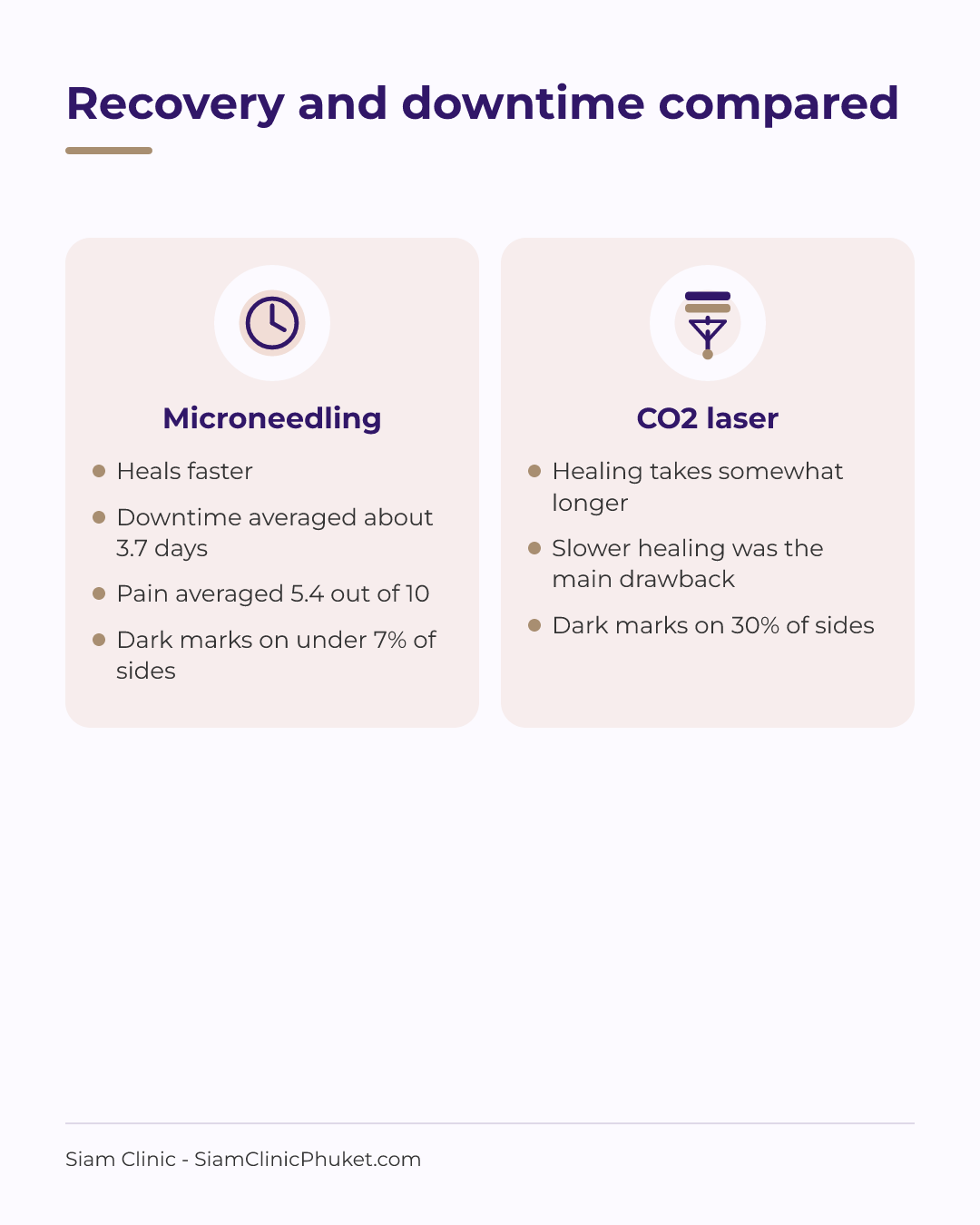
Laser healing takes somewhat longer. In the trials, that slower healing was the main drawback of laser, and no serious safety problems were reported for either treatment.
The bigger recovery difference is dark marks after healing (post-inflammatory hyperpigmentation). These appeared on 30% of laser sides against under 7% of microneedling sides, and the risk rose with darker skin types. If you have a trip or event booked, plan around the longer laser healing.
Skin tone and pigment risk
Darker skin is where the two treatments differ most. The risk of dark marks rose with higher Fitzpatrick skin types (the scale that grades skin from very fair to very dark).
That is why microneedling is often chosen as the safer option for Fitzpatrick types IV to VI. It is not risk-free, though. Dark marks still turn up fairly often after microneedling, and they usually fade over months, on their own or with topical treatment.
Microneedling combined with radiofrequency may be a middle path. It caused far fewer pigment changes than fractional laser in pooled trials, and recovery was shorter. Its results were often similar to laser overall, but those trials are small.
Scar type and how many sessions
Most mixed acne scarring is a combination of boxcar and rolling types, so a clinician looking at your skin in person has to judge which type dominates.
Plan on a course, not a single visit. The trials used four sessions a month apart, and the results were measured after that series.
Neither treatment erases scars. Expect improvement in depth and texture, with the amount varying from person to person.
Who should hold off
Wait if you have active, inflamed acne. Treating scars while breakouts are still flaring means new scars can form faster than old ones improve, so the acne is usually brought under control first.
Be careful with laser if you have a history of dark marks after skin injuries, or if you tan easily.
Hold off on either treatment if you have a skin infection or open sores in the area, or if the skin is freshly sunburned. Phuket's sun makes this a practical point: heavy sun exposure before or after a session raises the risk of pigment change, so plan treatment for a stretch when you can stay out of strong sun.
If you are unsure which category you fall into, a skin assessment before booking is the sensible step, and the clinic's fractional CO2 laser and microneedling pages list who is not suitable in full.
Further reading: A Randomized Study to Evaluate the Efficacy Fractional CO2Laser, Microneedling and Platelet Rich Plasma in Post-Acne Scarring - PubMed
This article provides general information only. It is not a diagnosis or personal medical advice. If you have symptoms or health concerns, please consult a qualified doctor.
About the author
siamclinicphuket
This article is based on the sources listed at the end.
Sources
- A Randomized Study to Evaluate the Efficacy Fractional CO2Laser, Microneedling and Platelet Rich Plasma in Post-Acne Scarring - PubMed
- A Randomized Study to Evaluate the Efficacy Fractional CO2Laser, Microneedling and Platelet Rich Plasma in Post-Acne Scarring - PMC
- Evaluating the Pros and Cons of Fractional CO2 Laser Versus Microneedling in Atrophic Acne Scars in the Skin of Color: A Split Face Study - PubMed
- Radiofrequency Microneedling Versus Fractional Laser for the Treatment of Atrophic Acne Scars: A Systematic Review and Meta‐Analysis - PMC
- Microneedling for the Treatment of Scars: An Update for Clinicians - PMC
- A Systematic Review Examining the Potential Adverse Effects of Microneedling - PMC
- Efficacy of Microneedling and CO2 Laser for Acne Scar Remodelling: A Comprehensive Review - PMC
